45 pull requests over a bank holiday weekend — and the week it took to recover
June 2026 · Ways of Working
In April I wrote about my three-environment workflow, and ended by saying I was in no hurry to collapse everything onto my phone. The walk from the sofa to the desk, I said, was doing useful work.
About two weeks later I tried it anyway.
The early May bank holiday weekend was coming up. Tend, my garden planner, had a long list of small improvements waiting, and Claude Dispatch was already part of my setup. I could message a task from my phone, and a Claude Code session would pick it up on my Mac at home, do the work, and open a pull request. I could test the result on my phone against a staging site.
So that's what I did. From Friday to Tuesday, between everything else a long weekend involves, I kept sending work.
By Tuesday there were 45 open pull requests.
It felt brilliant
I want to be honest about this part, because it would be easy to tell the story as a cautionary tale and skip it.
It was one of the most productive few days I've had on the project. An admin panel, a round of accessibility fixes, dark-mode corrections, layout changes tested on real phones, bug fixes linked to real issues. 187 commits, 39 new test files. The work was genuine, and most of it was good.
The speed wasn't the problem. Speed is the easy part now.
Then I sat down at my desk
When I sat back down at my Mac after the weekend, the shape of the weekend became obvious.
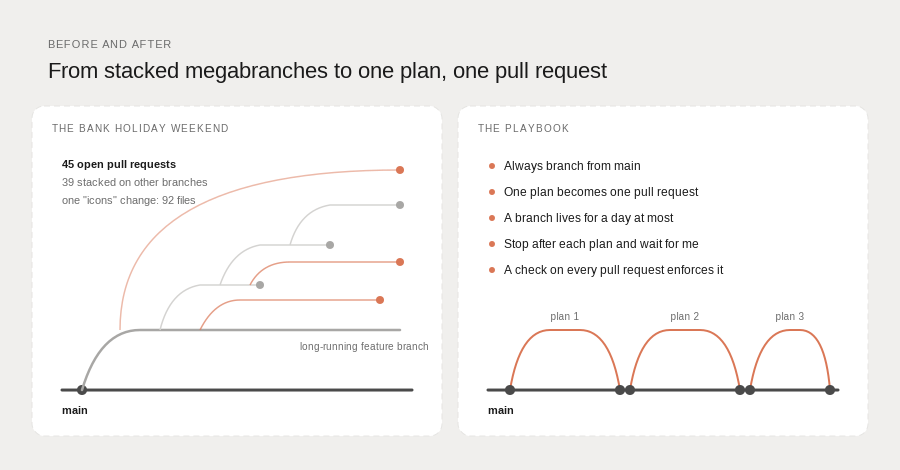
Only six of the 45 pull requests were based on the main branch. The other 39 were stacked on top of one long-running feature branch, and on each other. Several had quietly grown into what I started calling megabranches. One was supposed to add some icons and touched 92 files, because it carried half a dozen other changes along with it.
None of the usual structure had happened either. I use a planning workflow for Tend that goes discuss, plan, execute, verify, and it leaves a written trail of what was decided and why. Over the weekend I had skipped all of it. Each task had made sense in the moment. Together, nobody — including me — could say what had changed, in what order, or why.
The code was mostly fine. The history was a mess.
Untangling it
Recovery took most of the following week.
The first step was the most useful: I asked Claude to produce an inventory. Every pull request, every issue it touched, what depended on what, and a recommended merge order. That turned an overwhelming pile into eight groups that could be merged one at a time, in dependency order, each with its own review.
Some things didn't survive. Two pull requests were closed without merging, because their useful parts had already landed through other routes and the rest was contamination. One feature changed scope completely once I looked at it properly, from desk rather than sofa.
And one thing was a genuine win. Halfway through the clean-up, the careful review found a real production bug: a missing header that was blocking every signed-in request to the app's backend. It had been hiding underneath the noise. A slower, more structured pass found it.
By the end, everything was on main, each group had a review and a written summary, and the verification checklist passed. But I'd spent nearly as long tidying as I had building.
What I changed
I didn't stop using Dispatch. I wrote a playbook for it instead, and gave the project a set of rules that the Claude Code session reads every time it starts.
The first thing I had to correct was my own mental model.
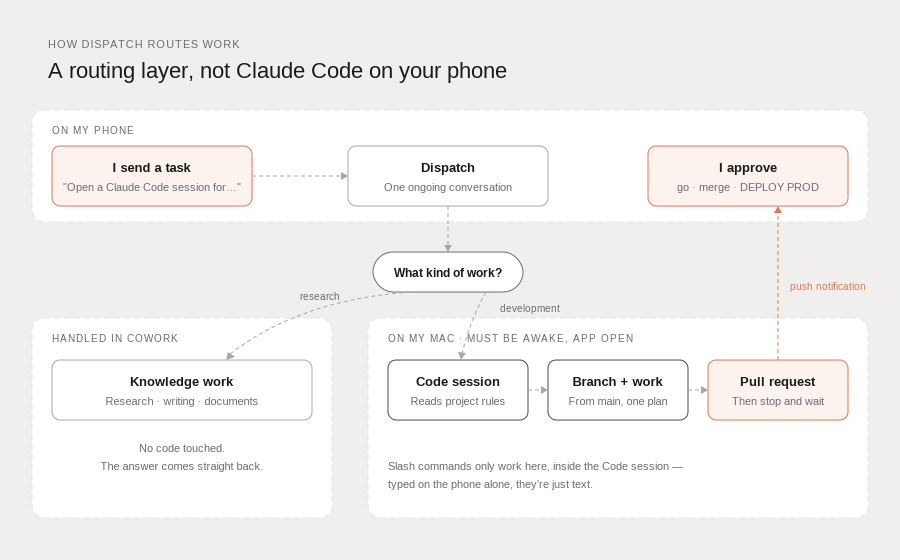
Dispatch is a routing layer, not Claude Code on your phone. It's one ongoing conversation, mirrored between my phone and Claude Desktop. When I send it something, it decides what kind of work it is. Research and writing get handled right there. Development work gets handed to a new Claude Code session on my Mac, which reads the project's instructions and does the work. My Mac has to be awake, and the app has to be open. Typing a slash command on my phone does nothing on its own, because slash commands only mean something inside that Code session.
Once I understood that, the rules followed naturally.
Thinking is always safe. Exploring an idea, capturing a note, writing a spec or a plan only ever touches the planning folder. I can do as much of that from my phone as I like.
Changing code has a shape. Every change starts from the main branch, never from another feature branch. One plan becomes one pull request. A branch lives for a day at most. And after each plan, the session stops and waits for me.
The bigger the action, the bigger the confirmation. Reading files and running tests happen silently. Pushing a branch needs a "go". Merging needs me to type "merge". A production deploy only happens if I type an exact phrase in capitals. That sounds fussy written down. On a phone, it's exactly the friction I want.
| Action | What I have to reply |
|---|---|
| Read files, run tests, write plans | Nothing |
| Push a branch, open a pull request | go |
| Merge to main, deploy to staging | merge / deploy staging |
| Deploy to production | DEPLOY PROD |
And a robot checks the rules. A check on every pull request rejects anything that breaks the shape: the wrong base branch, a branch older than a day, a missing summary. I don't have to remember the rules at eleven at night on the sofa. The system remembers them for me.
The real lesson
When I wrote the April piece, I thought the value of walking to my desk was the change in mental state — musing mode versus building mode. That's still true. But it was also where the structure lived. The planning workflow, the review, the habit of looking at the whole picture before merging: all of that was attached to sitting at the desk.
Dispatch removed the walk. It didn't remove the need for what happened at the end of it.
That's the pattern I keep seeing with AI tools. They remove friction, and most friction deserves to go. But some of it was doing a job you hadn't noticed. Before you take it away, it's worth asking what it was quietly holding up — and building that back in on purpose.
Speed is the easy part now. Structure is the part you have to bring yourself.
Posted by Envision8 · envision8.com