My three-environment workflow
April 2026 · Ways of Working
I don't do my best thinking at a desk.
Ideas tend to arrive in the gaps — while travelling, over lunch, in the evening while something's on in the background. If I had to be at my laptop to capture them, most of them would be gone by the time I got there.
That's the honest reason my workflow ended up the way it did. Not because I designed it, but because I needed it.
The three environments
I work across three tools, each with a distinct role.
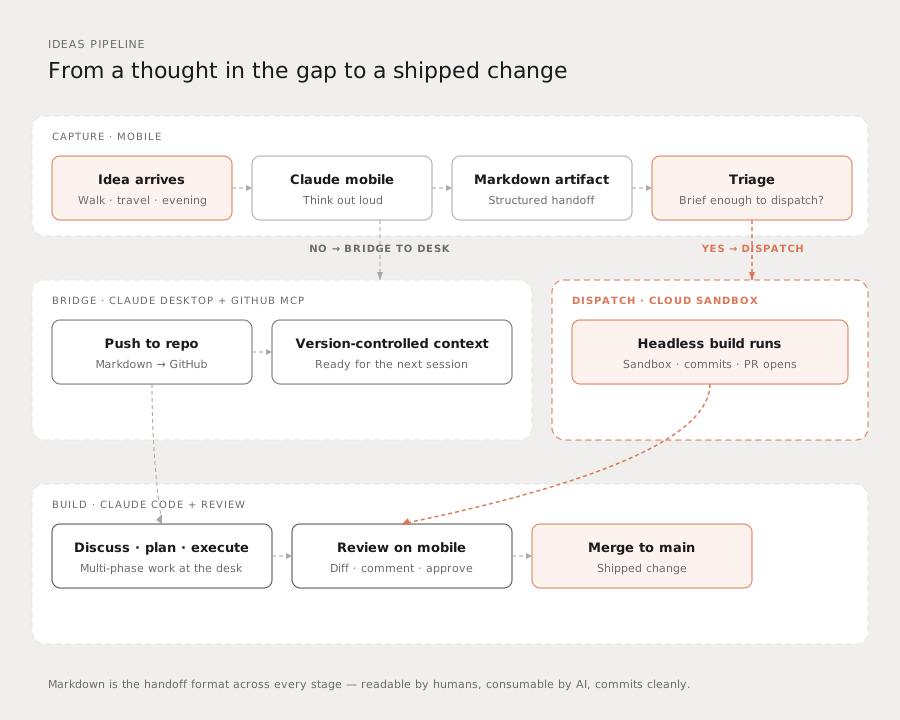
Claude on mobile is where thinking happens. When an idea surfaces — a journal post, a feature for a project, a way of approaching something differently — I open a chat and work through it. It's conversational and low friction. I'm not building anything yet, I'm just thinking out loud with a very capable thinking partner. The output is usually a markdown artifact: structured enough to be useful, lightweight enough to create anywhere.
Claude Desktop is the bridge. When I'm back at my desk, I use it with the GitHub MCP to push those mobile artifacts straight into the repository. No manual copying, no reformatting, no friction. What I captured on the sofa ends up version-controlled and ready to use, without me having to do anything twice.
Claude Code is where building happens. From the repository, a skill ingests the context and we move into a more structured mode — discuss, plan, execute. The ideas that started as casual conversation become properly engineered input for whatever I'm building.
Why it works
The thing that makes this flow hold together is the format. Markdown is the handoff language between all three environments. It's readable by humans, consumable by AI, and it commits cleanly to GitHub. Every tool in the chain can work with it natively.
If that standard broke down — if notes stayed as unstructured chat, or got scattered across apps, or never made it into the repository — the whole thing would fall apart. The format is the system.
What it feels like in practice
The best way I can describe it: ideas no longer wait for a convenient moment. They get captured when they arrive, processed when I have time, and built when I'm ready. The three environments aren't three separate workflows — they're one workflow that works across my day.
It's not complicated. It didn't take long to set up. And it's made a real difference to how much actually gets done versus how much just stays in my head.
If you're working with AI tools regularly, it's worth thinking about where your ideas actually come from — and whether your setup is designed around that reality.
Where it's heading — and where it's gone
The boundaries between these environments have started to blur faster than I expected. Claude Dispatch landed and quietly changed what's possible from a phone.
The mechanic is simple. From the Claude mobile app, you describe a task and dispatch it. A cloud environment spins up with access to your repository, clones it, and Claude works through the brief — running commands, making commits, opening a pull request — while you go and do something else. When it's done, you review the diff on your phone, leave comments, request changes, or approve and merge. No laptop required.
It isn't a remote shell or a screen-share into a desktop. It's a properly headless build environment that takes a written brief and returns a reviewable change.
What I actually use it for
Three patterns have emerged.
Small, well-scoped fixes. A typo on the site, a copy tweak, a styling adjustment I notice on my phone. Things I'd previously have to write down for later. Now I describe the fix, dispatch it, and a PR appears a few minutes later. By the time I'm back at my desk, it's often already merged.
Long-running tasks I can fire off and forget. Refactors, documentation passes, dependency upgrades — work that would otherwise tie up my local machine for an hour. I dispatch them before lunch and review what came back afterwards.
Keeping momentum while I'm away from the desk. If I've been mulling over a feature on a walk and the shape becomes clear, I don't have to wait until I'm back to start. I dispatch the first cut, let it run, and have something concrete to react to when I sit down.
How it fits the three-environment workflow
Dispatch doesn't replace any of the three environments — it extends what mobile can do.
Mobile is still where thinking happens. That hasn't changed. But mobile is now also where small, contained execution can happen, when the brief is clear enough to hand over without sitting at a keyboard. The bridge to the repository can be the dispatch itself, rather than a later push from Claude Desktop. And Claude Code on the laptop is still where deeper, multi-phase building happens — anything that needs me steering it in real time.
The rule I've settled on: dispatch is for work that's clear enough to write a brief for and small enough to trust. Anything ambiguous, exploratory, or architecturally significant still belongs at the desk.
What it actually changes
The honest answer is: less than I expected, and more than I expected.
Less, because I still don't want to build on a phone. The mental modes I described earlier — musing on mobile, building at the desk — still hold for anything substantive. Tapping out a long technical brief on a phone screen is no one's idea of fun.
More, because the gap between noticing something and fixing it has collapsed. Things that would have sat on a list for days now get handled in the time between meetings. The cost of capturing an idea and the cost of executing on it have moved closer together, and that quietly changes what feels worth doing.
The walk from the sofa to the desk is still doing useful work. But sometimes, now, the work is already done by the time I get there.
Posted by Envision8 · envision8.com