One source of truth, two dozen documents
June 2026 · Context Engineering
Part of my day job is designing services: the kind a business signs a contract for and then relies on for years.
A single new service needs a surprising amount of paperwork. A requirements document. A service description. A runbook for the people who operate it. A transition plan for bringing customers on and off. Catalogue entries for the service desk. Pricing. A statement of work. A contract schedule. A datasheet and a battlecard for sales. A training plan. Release notes.
Across the whole lifecycle, there are 24 distinct documents. Every one of them repeats some of the same facts: what the service is called, what it includes, what it explicitly doesn't, how quickly it responds, what it costs.
For a long time, the hard part was writing them. AI changed that. With a good skill and a clear schema, Claude can produce a solid first draft of any of them in minutes.
Which created a new problem.
Cheap documents, expensive inconsistency
When documents are slow to write, you write few of them and you know each one well. When they're fast to write, you end up with lots of them, and nobody holds them all in their head.
Then something changes. The service gets renamed. A feature moves into a higher tier. Something that was included becomes an exclusion. That last one matters most: if the contract schedule says something is excluded but the datasheet a salesperson handed over says it's included, you have a real commercial problem.
Generating documents faster doesn't fix that. It makes it worse. The more documents you can produce, the more places a fact can drift.
So I stopped thinking about the documents and started thinking about where the facts live.
One knowledge base per service
Every service now has a single structured knowledge base. It's a markdown file with fixed sections: identity, target clients, tiers, add-ons, features and scope (including exclusions), commercial terms, service levels, compliance, competitive context, gaps and risks, and the technical components underneath.
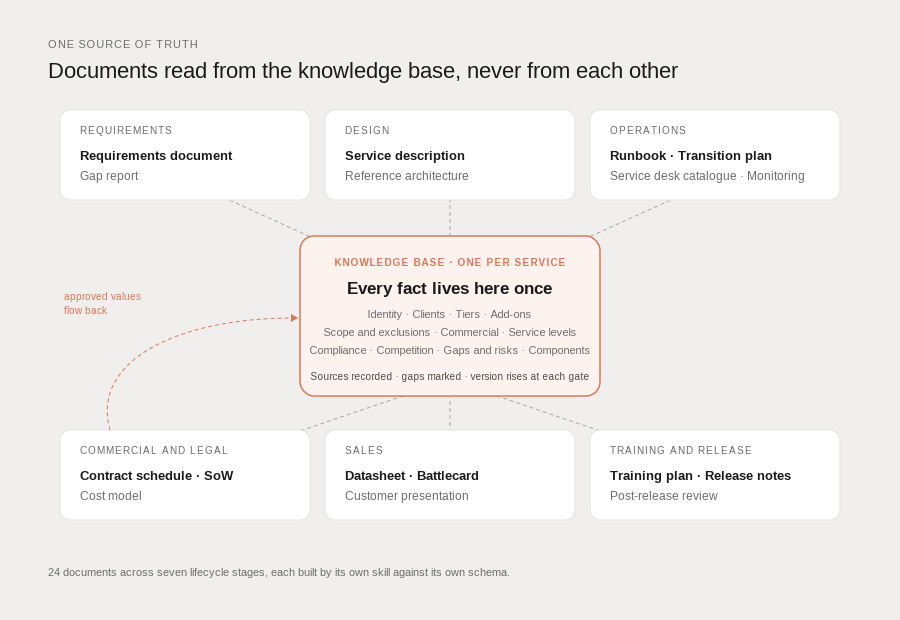
The rule is simple: documents read from the knowledge base, never from each other. The datasheet doesn't copy the service description. Both draw from the same source, each through its own skill and schema. If the source is right, everything built from it starts right.
Three details turned out to matter more than I expected.
Every fact says where it came from. Each section records its source and when it was captured: a legacy document, a design workshop, a finance input. Pricing is never inferred from anything else; it has to come from a named commercial source. When someone asks "where did this number come from?", there's an answer.
Gaps are marked, not filled. When the AI can't find something, it doesn't guess. It writes a visible gap marker, or a clearly labelled suggestion awaiting confirmation. A human has to resolve every marker before the knowledge base moves on. That's the single most important rule in the whole system. An AI that fills gaps confidently is far more dangerous than one that admits them.
It grows through gates. The knowledge base has a version number that only goes up when it passes a quality gate: intake, gap analysis, market validation, then each major document approved in turn. Version one is a rough intake. Version fourteen has survived the whole lifecycle.
The map of what depends on what
A single source solves the copying problem. It doesn't tell you what to do when the source changes. For that, there's a dependency map.
It's one document, with two views of the same information. The first view goes from section to documents: if this section changes, here's every document that reads it, which fields it uses, and how serious the impact is. The second goes the other way, from document to sections: if you're building this document, here's everything it must read first.
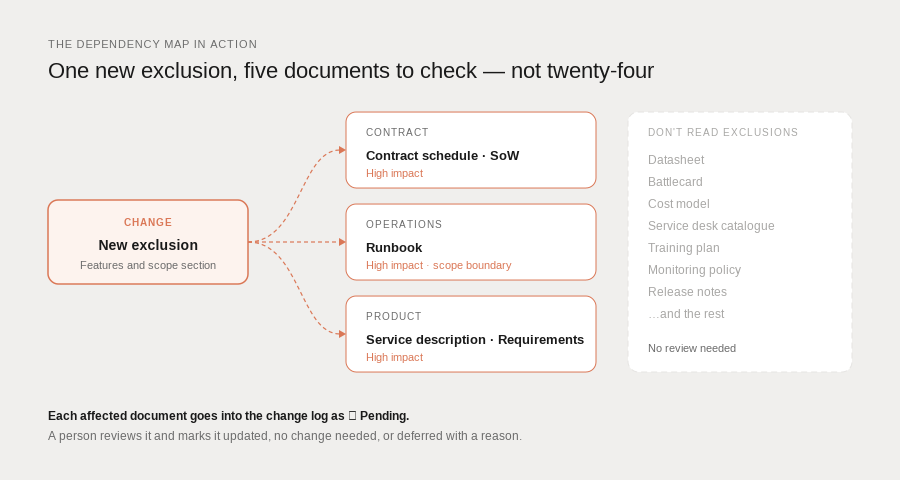
Writing it down forced some useful honesty. A change to the service name touches literally every document. A change to the competitive context touches just three: the battlecard, the datasheet and the requirements document. And a change to the exclusions is the riskiest of all, because it reaches the contract documents and the operational ones at the same time.
The log that tells you what to check
The last piece is a change log for each service. Every time the knowledge base is updated, a new row records what changed, where the new information came from, and which documents now need reviewing. The document list comes straight from the dependency map.
| Date | Section | Change | Assets to review | Status |
|---|---|---|---|---|
| 12/06 | Features and scope | New exclusion added | Service Schedule, SoW, Runbook, Service Description, PRD | ⬜ Pending |
| 12/06 | Service levels | Response target tightened | Service Schedule, Service Catalogue, Runbook | ✏️ Updated |
An illustrative example of the change log format.
Each document then gets a status: pending, in progress, no change needed, updated, or deferred with a reason. One line in the log template sums up the philosophy: updating a downstream asset is always a human decision. The log surfaces the need. It doesn't make the change.
The flow goes both ways, too. When a document is approved and its content is better than the draft it came from (contract terms confirmed by finance, say), those values flow back into the knowledge base, with the approved document recorded as their source. And when writing the runbook exposes a gap in the service description, that gap goes back into the knowledge base rather than being patched in one place.
What I've learned
AI has moved the bottleneck. Producing a document used to be the expensive part. Now it's keeping two dozen documents telling the same story. The answer isn't a better prompt. It's structure: one place where each fact lives, a written-down map of who depends on it, and a record of what needs checking when it changes.
It's the same idea I keep coming back to on this journal. The format is the system. A well-structured markdown file is readable by a person, usable by AI, and versioned in Git, and that combination is what makes everything built on top of it trustworthy.
The next step is obvious, and it's where I'm heading. Today, I look at the change log and work out what to regenerate. The map already knows which documents are affected. There's no reason the system can't propose the minimal change to each one for me to accept or reject.
But I wanted the manual version working first. If you can't explain the dependencies to a person, you shouldn't be automating them.
Posted by Envision8 · envision8.com